Real-time AI dashboards for data teams.
Stop being the bottleneck for every question. Let stakeholders self-serve answers with an AI data agent governed on your trusted data models.
Data teams don't lack requests. They lack a way to stop being the bottleneck.
What changes
From ticket queue to self-serve at scale.
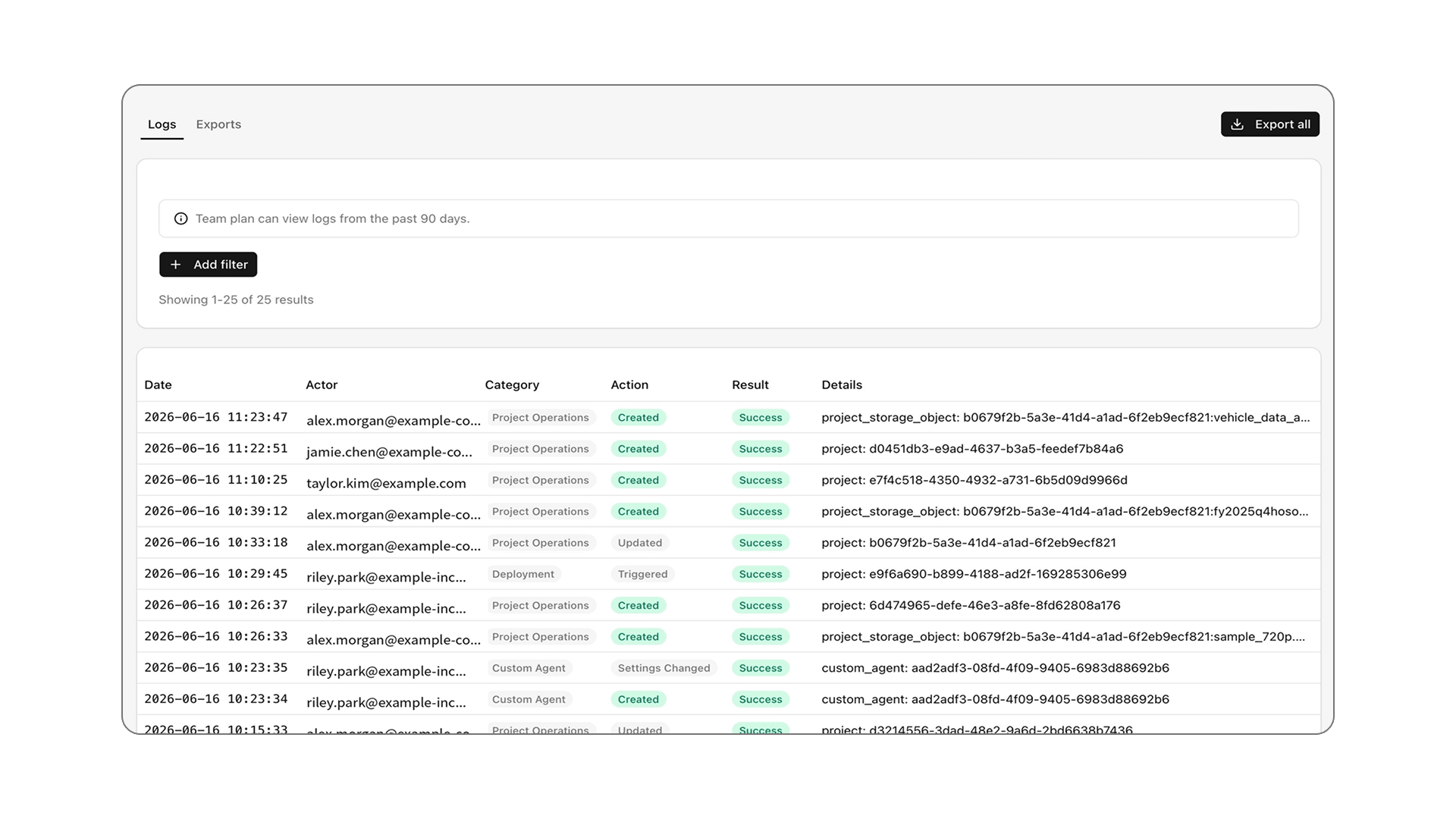
Governed self-serve, without the ticket queue.
The easy 80% self-serves. Your analysts reclaim time for high-leverage work.
- Self-serve on your semantic layer, not raw SQL guesses
- Fewer tickets, fewer context switches
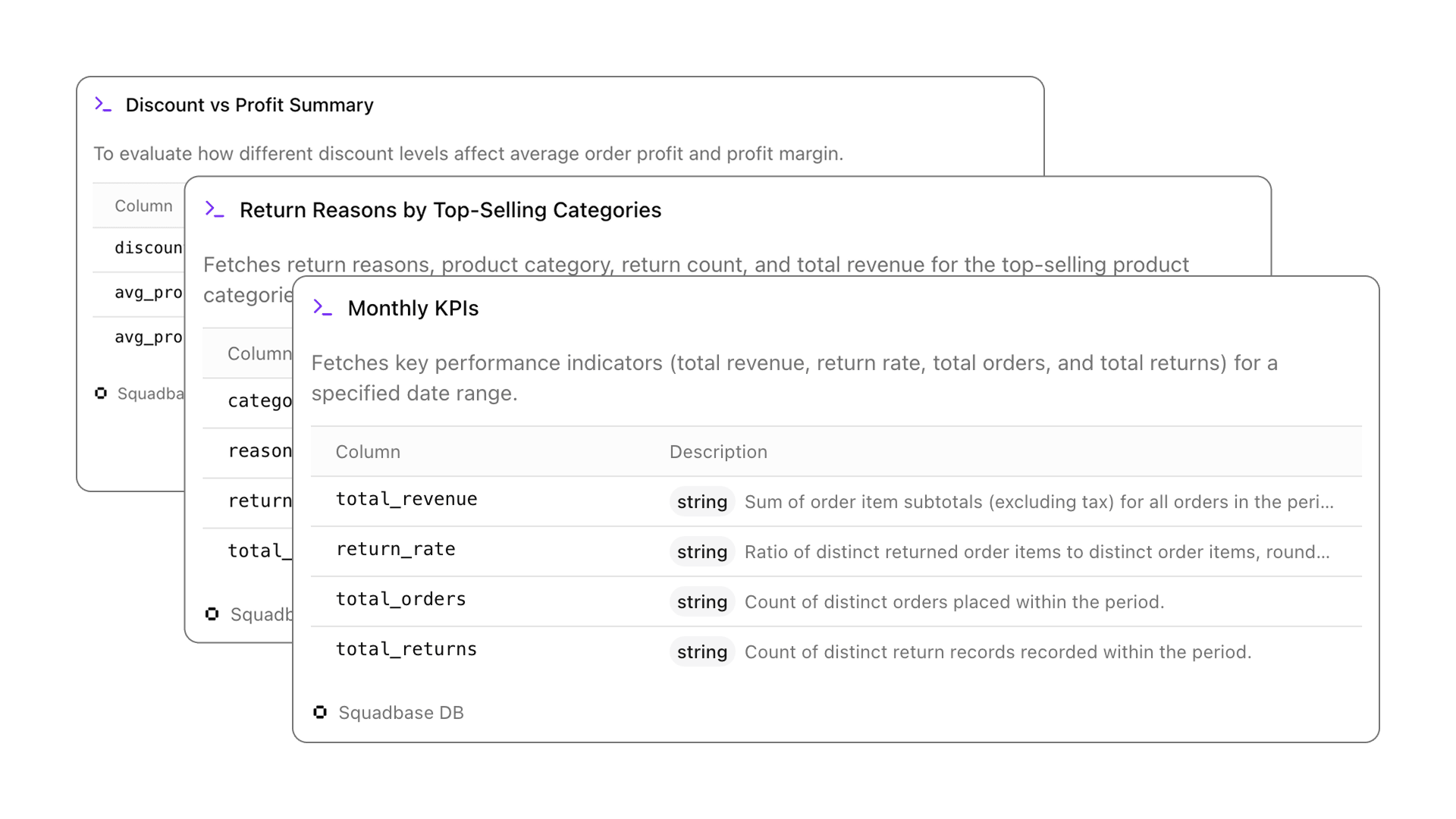
Trusted data models. One number, every team.
Every answer uses the metric definitions your team certified. No shadow metrics. No debates.
- Single source of truth across every stakeholder
- Definitions locked in as executable code, not free text
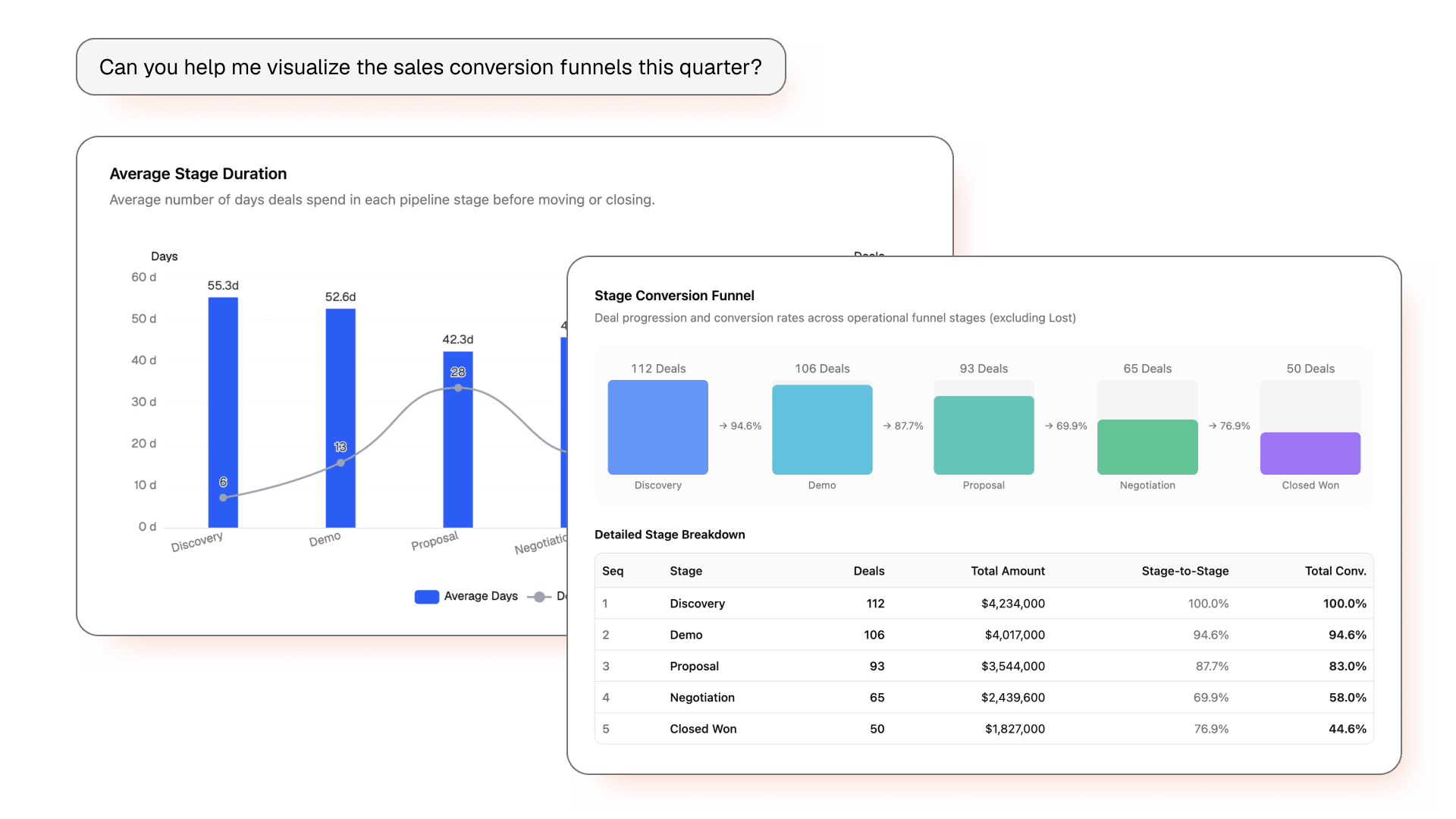
One agent across your whole data stack.
Connect once. The data team curates models once, the whole company benefits.
- Snowflake, BigQuery, dbt, Redshift, Postgres, Looker, Tableau
- No new data silo or migration required
Comparison
AI analytics vs. traditional analytics.
AI analytics | Traditional analytics | |
|---|---|---|
| Approach | Self-serve on governed models. | Analyst-built reports per request. |
| Speed | Real-time, instant answers. | Delayed by the ticket queue. |
| Governance | Grounded in your trusted semantic layer. | Definitions drift across teams. |
| Scale | Scales access without scaling headcount. | Bounded by analyst capacity. |
| Usability | Conversational. Stakeholder-friendly. | Requires SQL or BI skills. |
What data teams use it for
Less ad-hoc work, more leverage.
Deflect ad-hoc requests
Self-serve stakeholder questions
Fewer one-off report tickets
Reusable governed answersGovern metrics centrally
Single source of truth
Certified metric definitions
Consistent answers across teamsScale data access
Onboard non-technical users
Plain-English querying
No SQL bottleneckFocus on high-value analysis
Reclaim analyst time
Deeper modeling work
Proactive insight delivery
How it works
From data model to answer, in three steps.
01
Connect your warehouse and semantic models.
02
Stakeholders ask questions in natural language.
03
Get governed, AI-generated dashboards in seconds.
- AWS Athena
- AWS Billing
- Airtable
- Amplitude
- Asana
- Attio
- Azure Cosmos DB
- Azure SQL
- Backlog
- BigQuery
- ClickHouse
- ClickUp
- Customer.io
- Databricks
- Freshdesk
- Freshsales
- Freshservice
- Gamma
- Gemini
- GitHub
- Gmail
- Google Analytics
- Google Audit Log
- Google Calendar
- Google Search Console
- Grafana
- Hacker News
- HubSpot
- InfluxDB
- Intercom
- JDBC
- Jira
- Linear
- Mailchimp
- Mixpanel
- MongoDB
- MySQL
- Notion
- OpenAI
- Oracle Database
- Outlook
- PostgreSQL
- Power BI
- Redshift
- SQL Server
- Salesforce
- Semrush
- Sentry
- Snowflake
- Stripe
- Supabase
- Tableau
- TiDB
- Wix Store
- Zendesk
- dbt
- kintone
- monday.com























































Our stakeholders self-serve the easy questions now, so the data team finally has time for the hard ones.
Data team questions, answered.
Will self-serve answers stay governed?
Yes. The AI data agent reasons on top of your trusted semantic layer, so every self-serve answer uses the exact metric definitions your team has certified. Governance and speed stop being a trade-off.
Does this replace our data team?
No. Squadbase deflects the repetitive, low-leverage requests so your analysts can focus on high-value modeling work. The data team curates the models once, and the agent handles the rest.
Which parts of our stack does it connect to?
Squadbase connects to Snowflake, BigQuery, dbt, Redshift, Postgres, Looker, Tableau, and spreadsheets. It works across your existing stack without forcing a new data silo or migration.
Can non-technical stakeholders use it safely?
Yes. Stakeholders ask questions in plain English and get answers grounded in your governed data models. They never touch the underlying SQL or schema directly.
How does Squadbase keep metric definitions consistent?
Business definitions are stored as tested, executable code rather than free-text descriptions. Every answer runs the same certified logic, so you get the same correct number every time, regardless of who asks.
Stop being the bottleneck. Let everyone self-serve.
Scale data access without scaling headcount, with an AI data agent governed on your trusted models.