Introducing Squadbase Public Beta

Today, we're launching the Squadbase Public Beta.
With Squadbase, you can ask questions of your data freely, then hand off the questions you need to revisit again and again. AI keeps running those checks and sends the results to Email or Slack when something worth your attention changes.
We're not building BI just to make analysis faster. We're building toward a world where people no longer have to keep checking their data, because important changes come to them.
We call this direction Data Autopilot.
AI made analysis cheaper. It didn't remove the work of checking.
AI has dramatically lowered the cost of asking questions of data. You no longer need SQL to get started. Analyses that used to take hours can take minutes. Even dashboards can now be generated by AI (AI dashboards). That is real progress.
But the basic way we use BI has barely changed. Someone still has to open a dashboard, look at the numbers, notice that something changed, and decide what to ask next. Even with a copilot in the middle, a person still has to start the process.
AI has moved between people and their data, but people are still the ones who have to remember to look. We think that should change.
AI should look at the data first, and when something worth knowing happens, the change should come to you. As we wrote before, analysis may become abundant, but human attention will not.
So the next generation of BI should not only be measured by how much analysis it can produce. It should be measured by how much less data people have to go looking for.
Data Autopilot needs a goal
Once AI starts looking at data before people do, a new question appears: what should it look for?
A 5% change in revenue is not meaningful by itself. Whether it matters depends on this quarter's goals, the KPIs you are tracking, acceptable ranges, initiatives already in motion, known exceptions, and what your team can actually do when something changes.
In other words, an autopilot needs a destination. And that destination usually does not live with one individual or with the company as a whole. It lives with a smaller group of people working toward the same business outcome.
We call a team that shares a business goal or KPI, and acts together when that number moves, a Squad. A Customer Success team may own customer health and renewals. A GTM team may own pipeline. A Product team may own activation or retention.
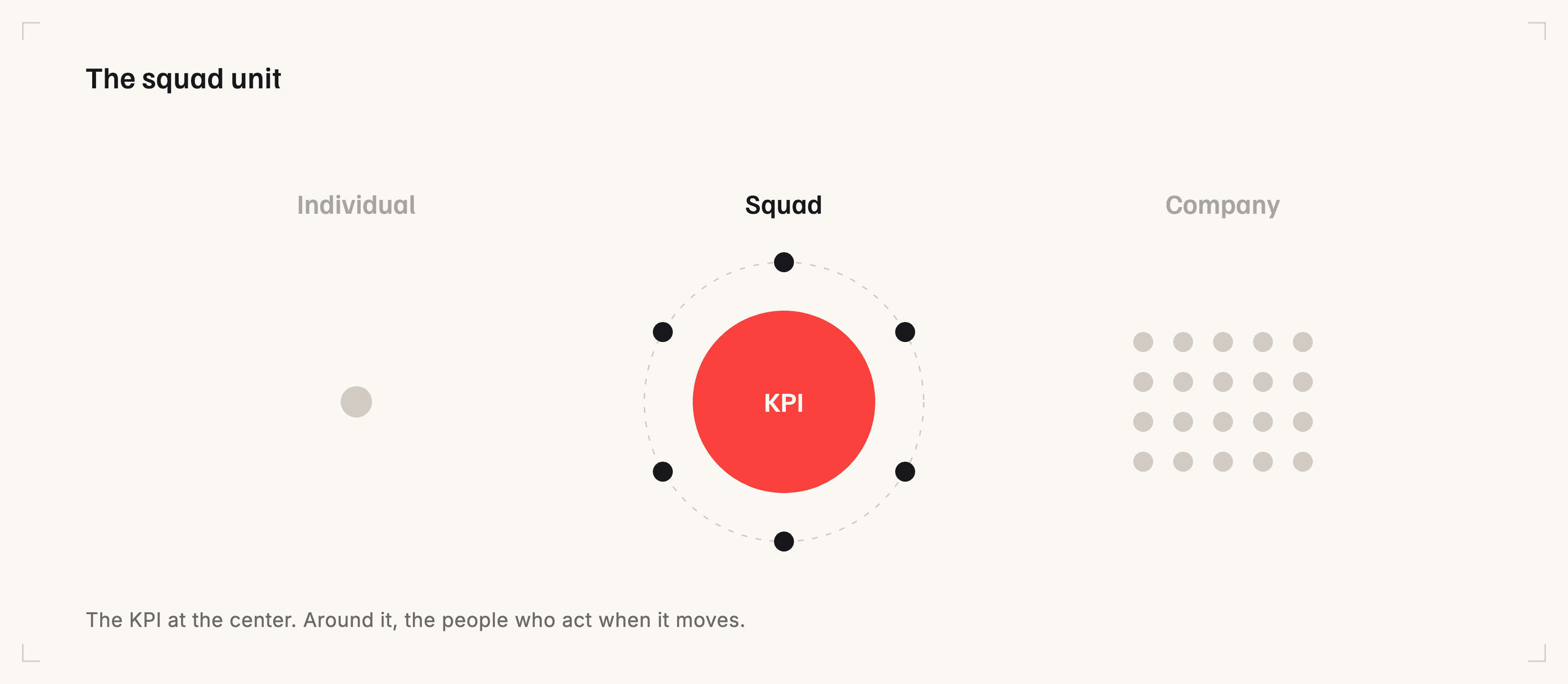
A Squad has KPIs it cares about. Over time, it builds context around why those KPIs matter right now. And when something changes, there are people who can actually do something about it.
For Data Autopilot to work, it is not enough for AI to see the numbers. It also needs to understand what the Squad is trying to accomplish, which KPIs matter, how much movement is worth attention, what initiatives are already underway, and which exceptions the team already knows about.
That context is what allows AI to distinguish between a large change and an important change. Only once AI knows what is worth watching can the work of watching it be delegated continuously.
If a Semantic Layer tells AI what a number means, the Squad's context tells AI why that number matters to this team right now. We wrote more about how this context should be given to AI in our previous post. It is also why we named the product Squadbase. We want to build Data Autopilot around this unit.
Data Autopilot should be measured by what people stop looking at
The analogy to autonomous driving is useful here. Progress in autonomous driving is not really about how many features a car has. It is about how much of the road people no longer have to continuously watch and operate themselves.
We think Data Autopilot should be measured the same way. Not by the number of AI features, but by what people no longer have to keep looking at.
First, people stopped looking at SQL because they could ask questions in natural language. Then they started spending less time manually building datasets and dashboards from scratch because AI could help create them.
The next thing to disappear is the repeated work of checking the same charts and numbers over and over again. AI can do the checking and only bring people in when something matters. Over time, we believe people will stop opening data simply to ask, "Did anything change?"
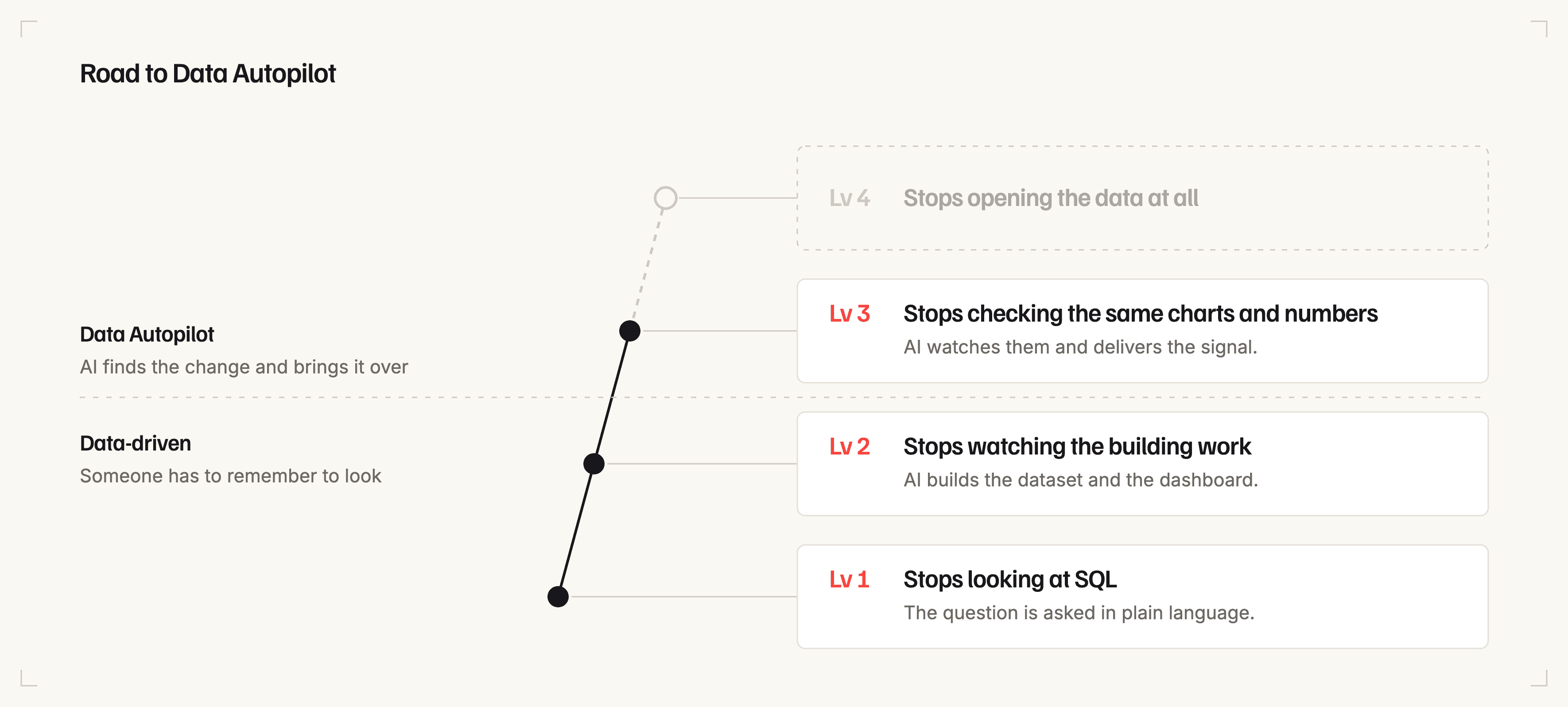
Dashboards will not disappear. Their role will change. Instead of being the place where every workflow begins, they become the place you go to verify a signal and investigate further after something has already been brought to your attention.
A question can become something AI keeps watching
We do not want to build one product for asking questions and another product for recurring reports. We want one question to naturally become something that keeps running, brings changes back to you, and continues all the way through verification and decision-making.
When a new question comes up, you ask the data. If that question turns out to be something you need to check every week or every month, you can hand that check over to an AI data agent. The agent keeps running it. When something changes, the result comes to you, before anyone has to remember to open a dashboard.
And the workflow does not end with a notification. From the same thread where the signal arrives, you can verify what happened, ask follow-up questions, investigate the underlying data, and decide what to do next.
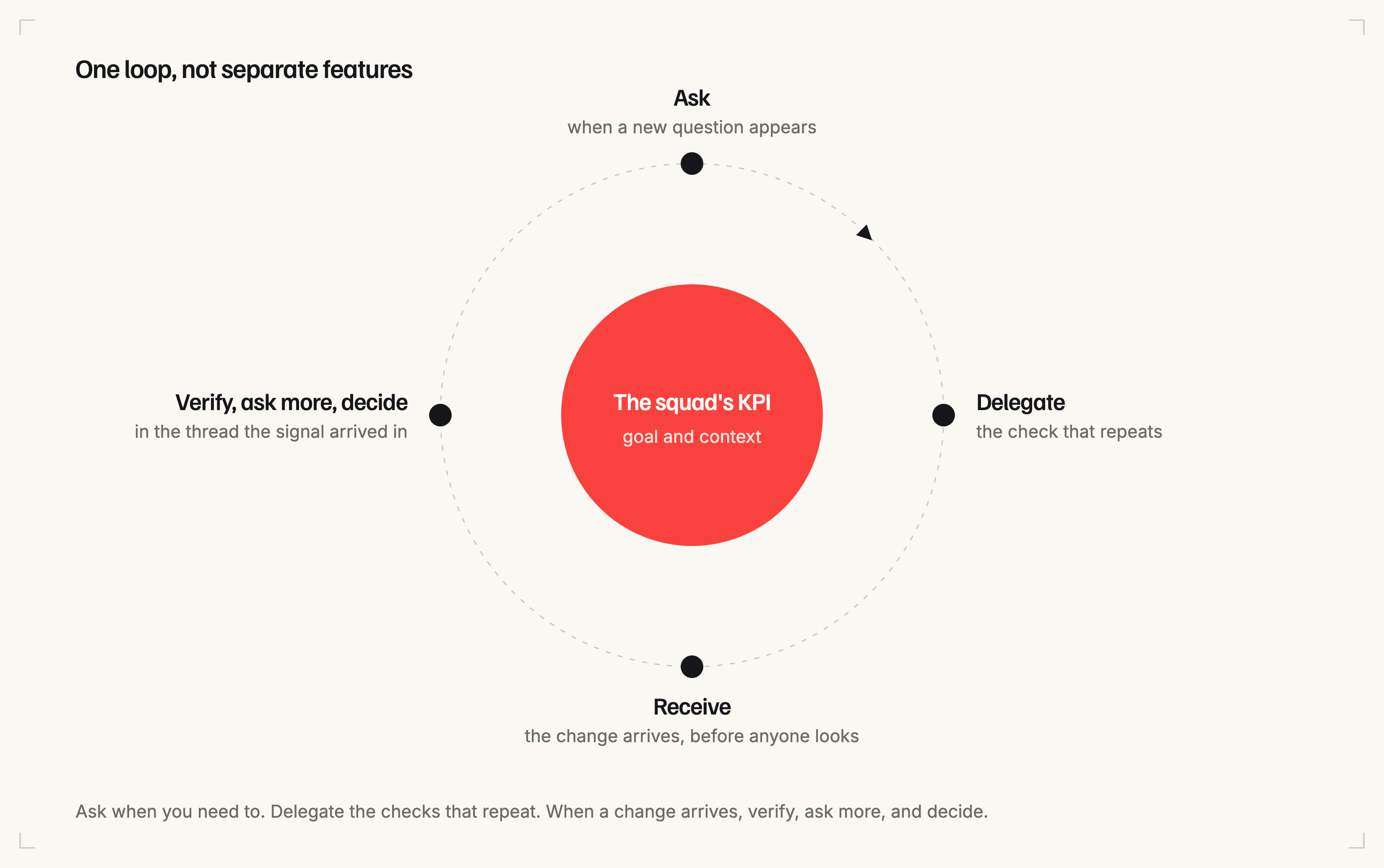
That is the experience we want Squadbase to create: ask when you need to, delegate the checks that repeat, and when a change arrives, stay in that context to verify it, ask more, and make a decision. These are not separate features to us. They are parts of one continuous loop. That loop is what we mean by Data Autopilot.
There is also a deliberate boundary in the product today. AI continuously watches only what a Squad has explicitly asked it to watch. It does not roam through your data looking for unsolicited changes or decide on its own what your team should care about.
The best fit for Autopilot today is the work that repeats every day, week, or month, and usually finds nothing unusual. Questions that arise in the moment, or only need to be answered once, should still be asked freely when they come up.
Available to everyone today
Squadbase Public Beta is open to everyone today, with no waitlist or application required. You can sign up and start for free. Squadbase currently has more than 50 supported connectors, including data warehouses and databases such as PostgreSQL, Snowflake, and BigQuery, SaaS products such as Salesforce, and uploads from Excel.
Viewer seats are free on every plan, so you do not need to pay for every person who needs to see the data.
To get started, pick one number that someone on your team currently remembers to check every morning, every week, or every month. Then hand that check to AI.