Beyond “Ask Your Data”: When Data Speaks First

AI scales analysis. Human attention does not.
AI made it easier to ask questions of data. It did not make attention scale
For two decades, business intelligence tools have made one side of a two-sided problem easier: producing analysis. Cloud warehouses lowered the cost of storing data. Modeling layers made definitions reusable. Visualization tools made charts faster to build. Now conversational analytics can turn a question into SQL, a chart, and a report page.
That is real progress. But “ask your data” still preserves an old assumption: a person has to know when to ask.
At the same time, AI expands the supply of analysis without expanding the working day of the person expected to consume it. Human attention is as finite as it was before any of these tools existed.
Herbert Simon described the underlying economics in 1971: “a wealth of information creates a poverty of attention.” As information becomes abundant, the scarce resource shifts to the recipient’s time and attention. AI makes that old problem more acute because it can increase the supply of analysis far faster than the working day can expand.
That asymmetry will define the next era of BI. Analysis is becoming abundant. Attention is not. A category built on the assumption that people will keep checking everything we create has to change shape.
Analysis is becoming abundant
AI-powered analytics dashboards can already generate calculations, visualizations, and report pages from natural language. More broadly, AI tools for data analysis are turning work that once required an afternoon of SQL and formatting into a question. Teams can create and maintain far more analysis than before.
Analysis is not free. Data still needs to be modeled, definitions need to be trusted, and someone must remain accountable for correctness. The narrower claim is more important:
The marginal cost of producing analysis is falling much faster than the cost of consuming it.
Every new dashboard is also another surface someone is expected to watch. We are about to learn what happens when the number of things worth examining grows rapidly while the time available to examine them does not.
Every dashboard has a hidden requirement
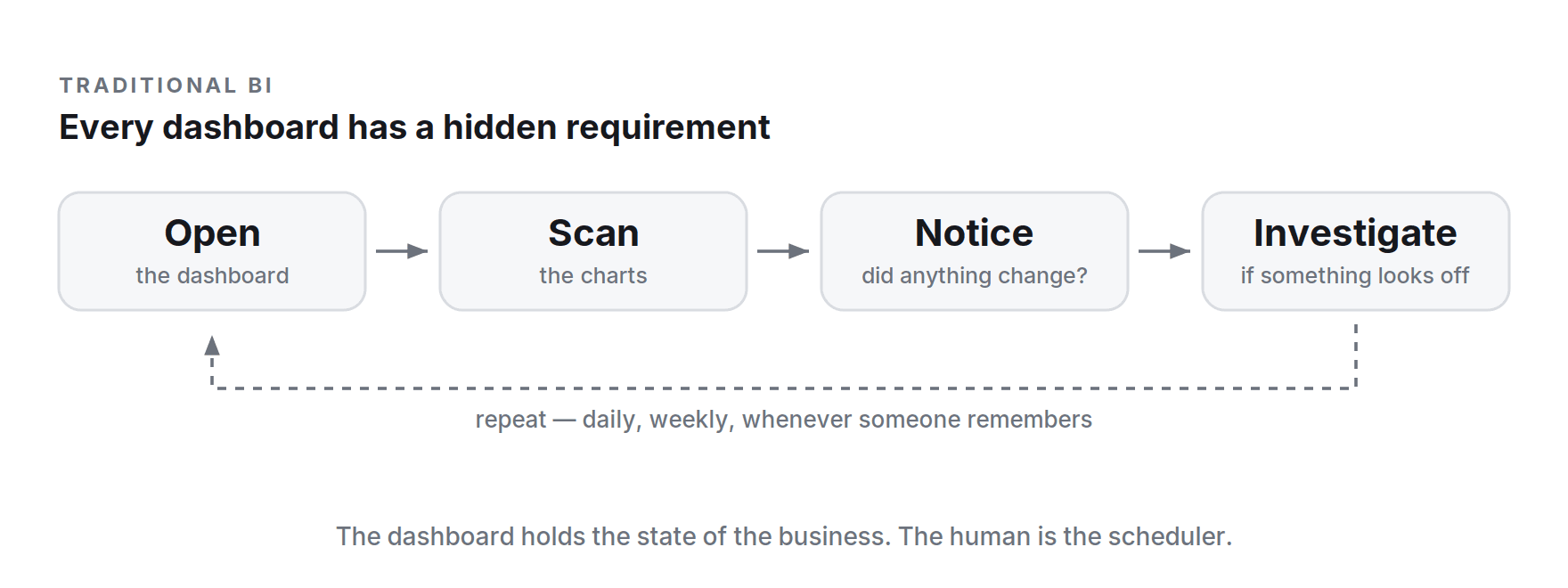
Traditional BI comes with an unstated contract: if you do not want to miss something important, keep checking.
A dashboard holds the state of the business, but it does not decide when that state deserves attention. The person opening it supplies the schedule, change detection, and escalation. In systems terms, a dashboard is a polling interface operated by humans.
That design produces a familiar routine: open the same tabs every Monday, scan charts that look almost identical to last week's, and discover an important change late because the person who usually checks was away. Making dashboards easier to build only multiplies the surfaces competing for the same attention.
Asking is still a pull interface
Conversational analytics is a genuine improvement. Asking a question in plain language and receiving an answer from governed data removes a bottleneck that kept much of a company dependent on the data team.
But the initiative still belongs to the user. With a dashboard, the user decides when to look. With chat, the user decides when to ask and what to ask about.
"Ask your data anything" is a better interface for exploration. It is still a pull interface.
That distinction matters most in monitoring. The most valuable question is often the one nobody knew to ask on the day it mattered. Making answers easier to obtain does not help when the question is never asked.
The next shift: data speaks first
The important shift is not the screen. It is who initiates the interaction.
AI data agents can run recurring investigations, begin analysis when a metric changes, and deliver findings into the tools where teams already work.
Push delivery itself is not new. Scheduled reports and threshold alerts have existed for decades. What is changing is the locus of initiative. Software can move beyond firing a static message. It can notice a change, investigate it, compare it with relevant context, and decide whether a person should pay attention.
Scheduling and AI-written summaries will quickly become baseline capabilities. The harder design problem is whether the system knows when to speak, can show why it spoke, and can support the next question. The shift is not simply from dashboards to notifications. It is from software that waits to be queried to software that can responsibly act first.
When data speaks first, BI becomes event-driven
When data can initiate the interaction, BI no longer has to revolve around queries or dashboard visits. It can respond to changes in the business itself.
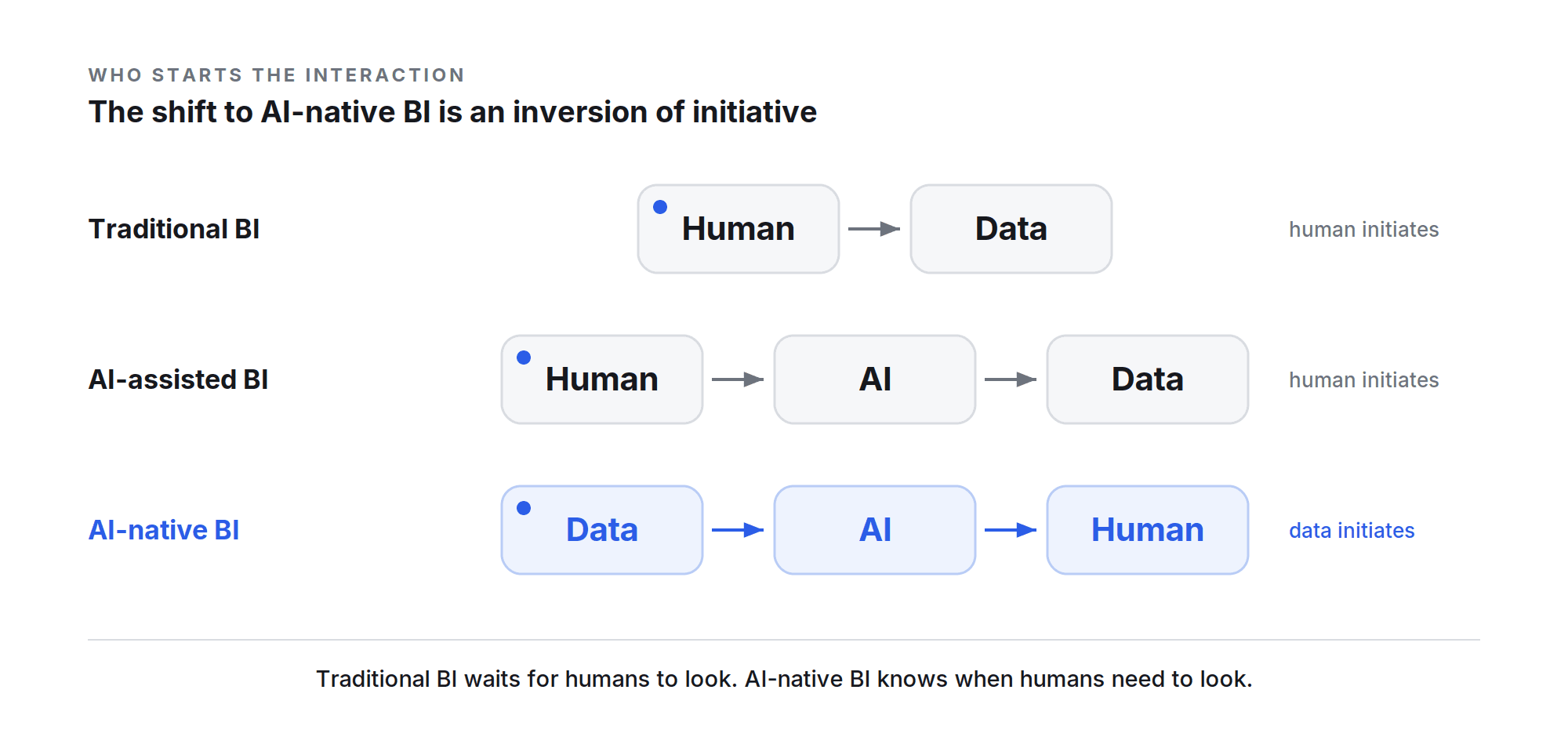
In traditional BI and AI-assisted BI, a person starts every interaction. In AI-native BI, a change in the business can start it. The model becomes event-driven rather than query-driven: software notices, investigates, and brings a person in when judgment is required.
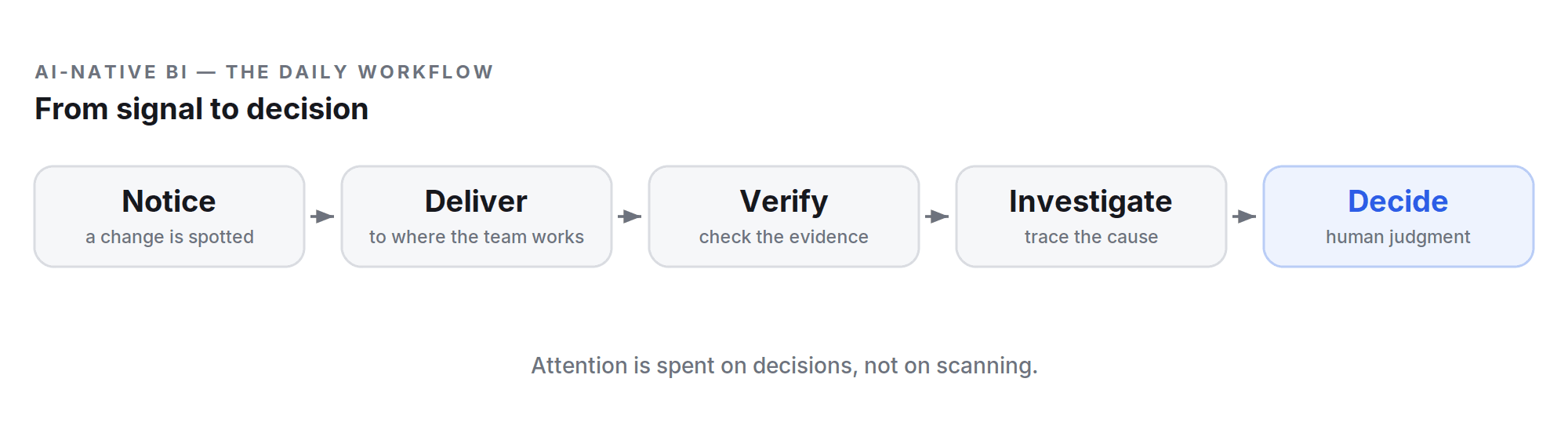
This does not mean data decides what matters. AI evaluates change against goals, priorities, thresholds, and exceptions defined by the team. The human role remains essential, but it moves from repeated scanning to verification, investigation, and decision.
Traditional BI waits for people to look. AI-native BI should know when people need to look.
That also changes how the product should be judged:
AI-native BI should not be measured by how much analysis AI can generate. It should be measured by how much human attention it gives back.
Dashboards will not disappear. They will stop being the homepage of BI.
Dashboards still have an important role, but that role moves downstream.
Today, the dashboard is the front door. You open it to discover whether anything happened. In an event-driven model, discovery becomes the AI's job. The dashboard is where you go after a signal to verify the claim, see the metric in context, investigate the segment, and establish a shared view with the team.
That is a demotion from homepage and a promotion in importance. When AI says the business has changed, the surface that proves the claim becomes more valuable, not less.
When AI acts first, verification matters more
An AI system that asks for human attention has one non-negotiable requirement:
It must also provide the evidence needed to verify its claim.
A message that says "your business changed" is not enough. The recipient needs to see what changed, compared with what, in which metric and segment, and based on which evidence. They also need a direct path to ask a follow-up question and investigate further. Without that path, the system is only another notification, and people are already very good at ignoring notifications.
Squadbase is designed around this continuity. Reports, dashboards, and the queries and data behind them remain connected inside the same project. The agent's work remains visible in a thread, so the recipient can continue the investigation from the original context and trace the conclusion back to its evidence without switching between products. This is not a convenience added after delivery. It is the foundation of trust.
AI will sometimes miss a change or misjudge its importance. That is precisely why trusted metrics, explicit monitoring coverage, and human verification are structural parts of the experience, not accessories to it.
The goal is no longer just to make data easier to ask. It is to let data speak first, and to make every signal easy to verify when it does.
The next bottleneck is context
Once AI can watch the business continuously, a new problem appears. It can detect thousands of statistically interesting changes. A team can seriously engage with only a handful.
Detection is the easy part. Relevance is harder because importance is not a property of the data alone. A 10 percent decline can be expected seasonality for finance and an urgent problem for the owner of a campaign launched last week. A customer success team may care much more about a usage decline before renewal than about the same movement in an aggregate metric. What deserves attention depends on the goals, segments, thresholds, and operating judgment of the team that owns the outcome.
This creates two practical questions. How does AI learn what matters to that team? And when the team's priorities change, how does the monitoring change without another implementation cycle through the data team?
The data team should continue to govern metric definitions, trusted sources, and access. The teams responsible for outcomes should keep current priorities and attention criteria up to date. The next essay, Beyond the Semantic Layer: Context Engineering for Business Teams, explains why those two kinds of context need different owners, how they meet in one architecture, and why that division is necessary for AI-native BI to work.